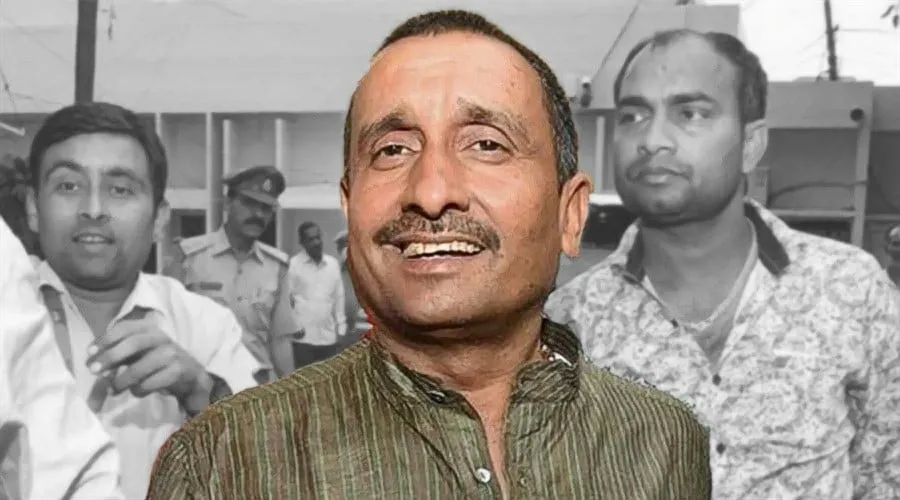
Unnao: For more than two decades, Kuldeep Singh Sengar embodied a familiar figure in Uttar Pradesh’s political landscape: the strongman leader whose authority flowed less from ideology and more from caste loyalty, local dominance, and an ability to deliver “help” where the state often failed. A prominent Thakur leader from Unnao district, Sengar built a formidable political career through party-switching, electoral success, and a carefully cultivated image of accessibility. Yet, the very power that enabled his rise would later become central to one of India’s most disturbing cases of political impunity, sexual violence, and institutional failure—the Unnao rape case.
A Feudal Rise in Rural Uttar Pradesh
Born into a locally influential family, Kuldeep Singh Sengar rose in a region where politics has long been shaped by caste arithmetic and muscle power. Unnao district, historically dominated by Brahmins, also hosts a sizeable Thakur population, alongside a significant Muslim electorate. Thakurs, while not the largest bloc, have traditionally exercised disproportionate control through land ownership, networks of patronage, and local strongmen politics.

Sengar’s ascent reflected this feudal-style political ecosystem. Loyalty was cultivated not through manifestos but through personal relationships, financial assistance, and the ability to “get things done.” In villages starved of infrastructure and timely justice, proximity to power mattered more than ideology.
He began his political journey in the early 1990s with the Indian National Congress. However, his real breakthrough came in 2002 when he contested the Unnao Sadar seat on a Bahujan Samaj Party (BSP) ticket. His victory was historic—the first BSP win in the constituency—establishing him as a formidable local leader.
But loyalty to party lines proved fluid. Expelled from the BSP over allegations of anti-party activities, Sengar joined the Samajwadi Party (SP), where his political fortunes only grew stronger. He won the Bangermau seat in 2007 and later Bhagwant Nagar in 2012. By then, his reputation as a man who could “help” had spread far beyond caste boundaries.
Villagers recall how Sengar was known for attending weddings, intervening in disputes, and offering cash assistance—sometimes thousands of rupees—for marriages, medical emergencies, or legal troubles. Such gestures created deep personal obligations. His wife, Sangeeta Sengar, further extended the family’s influence when she became the Zila Panchayat chairperson, embedding their authority into local governance.
In 2017, in the middle of the assembly elections, Sengar made another dramatic switch—this time to the Bharatiya Janata Party (BJP). Riding the saffron wave, he won Bhagwant Nagar yet again. His proximity to influential Thakur leaders like Arvind Singh Gope and Raghuraj Pratap Singh, popularly known as Raja Bhaiya, cemented his stature as one of the most powerful legislators in the region.
Power and Alleged Impunity
With power came a sense of invincibility—at least, that is what the unfolding events would later suggest.
On June 4, 2017, a 17-year-old girl from Makhi village approached Kuldeep Singh Sengar seeking help for employment. According to the prosecution, she was lured by Shashi Singh, an associate of Sengar, and taken to his residence. There, she alleged that she was gang-raped by Sengar and others.
The girl went missing briefly before being found. When she approached the police, she alleged sexual assault but claimed she was pressured not to name Sengar. What followed was not immediate justice but a chilling demonstration of how power can bend institutions.
For months, her complaints went unheard. FIRs were not registered. The family was harassed and intimidated. The machinery of the state, rather than protecting a minor survivor, appeared aligned against her.
A Father’s Death and a Nation’s Outrage
The turning point came in April 2018, but at a devastating cost.
After the survivor accused Sengar’s brother Atul Singh Sengar and his aides of assaulting her father over a land dispute, the father was arrested on what the family alleged were false arms charges. In police custody, he was brutally beaten. Videos of the assault later surfaced, shocking the public. On April 9, 2018, he died from his injuries.
By then, the family had been pushed to the brink. On April 8, 2018—one day before her father’s death—the survivor attempted self-immolation outside Chief Minister Yogi Adityanath’s residence in Lucknow, clutching a placard accusing Sengar of rape and the police of inaction.
The dramatic act pierced public indifference. The case exploded into national consciousness.
Judicial Intervention and CBI Probe
The Allahabad High Court took suo motu cognizance, sharply criticising the Uttar Pradesh Police for complicity and failure. Under mounting pressure, the case was transferred to the Central Bureau of Investigation (CBI).
On April 13, 2018, the CBI arrested Kuldeep Singh Sengar and Shashi Singh. Charges were filed under Section 376 of the Indian Penal Code and the stringent provisions of the Protection of Children from Sexual Offences (POCSO) Act, among others. The BJP initially suspended Sengar and expelled him from the party in 2019.
But the tragedy did not end there.


The Rae Bareli Crash
On July 28, 2019, the survivor was travelling with her lawyer and two aunts in Rae Bareli when a speeding truck rammed into their car. Both aunts were killed instantly. The survivor and her lawyer were critically injured.
The family alleged a conspiracy to silence her. While the CBI later ruled the crash unintentional, it nonetheless charged Sengar and his associates with criminal conspiracy, intimidation, and attempts to influence witnesses—underscoring the atmosphere of fear surrounding the case.
Supreme Court Steps In
Recognising the gravity and complexity of the matter, the Supreme Court intervened decisively. On August 1, 2019, a bench led by then Chief Justice of India Ranjan Gogoi transferred five related cases—from the rape to the father’s custodial death and the accident—to Delhi’s Tis Hazari Court.
The Court ordered daily hearings, CRPF security for the survivor, ₹25 lakh compensation, and relocation of witnesses. The message was clear: justice would not be derailed by influence.
Conviction and Life Sentence
The trial proceeded swiftly. On December 16, 2019, Kuldeep Singh Sengar was convicted of rape under the IPC and aggravated sexual assault under the POCSO Act, the court holding that he had abused his position as a public representative to commit the crime.
Four days later, on December 20, 2019, he was sentenced to life imprisonment till the remainder of his natural life, along with a ₹25 lakh fine, part of which was to be paid to the survivor.
In March 2020, he was also convicted for criminal conspiracy in the custodial death of the survivor’s father and sentenced to ten years’ rigorous imprisonment.
A Controversial Turn in 2025
After more than seven years in jail, the case returned to the spotlight in December 2025. On December 23, the Delhi High Court suspended Sengar’s life sentence pending appeal and granted him conditional bail. The ruling sparked immediate controversy.
Most contentious was the High Court’s observation that aggravated POCSO provisions might not apply, reasoning that Sengar, at the relevant time, was not a “public servant” since his tenure as an MLA had ended. Legal experts pointed out that this interpretation clashed with established precedents that treat elected representatives as public servants for acts committed during or by virtue of their office.
The survivor described the order as a “death sentence” for her family, citing security lapses and renewed threats. Protests erupted in Delhi, including at Jantar Mantar and near Parliament, with several activists detained. The survivor also approached the CBI seeking an FIR against the original investigating officer, alleging collusion.
Supreme Court Stay and Renewed Hope
Within days, the Supreme Court intervened again. On December 29, 2025, a bench led by Chief Justice of India Surya Kant stayed the Delhi High Court’s order. Noting the “peculiar facts” of the case, including the separate ten-year sentence in the custodial death matter, the Court ensured that Sengar would remain behind bars.
The bench issued notice to Sengar, provided legal aid to the survivor, and scheduled further hearings. Expressing relief, the survivor said she would not rest until full justice was secured. Her mother thanked the Court for standing by them when institutions had earlier failed.
A Case That Exposes the System
The Unnao case is not merely the story of one powerful politician’s fall. It lays bare the darker underbelly of India’s political and administrative systems—where caste dominance, police collusion, and fear can delay justice for years.
It also raises larger questions: Should prolonged incarceration automatically lead to bail in heinous crimes? How should courts balance the rights of the accused with the safety of survivors? And can interpretations of laws like POCSO inadvertently weaken protections meant for the most vulnerable?
Eight Years On
As of December 29, 2025, Kuldeep Singh Sengar remains in jail, his appeals pending. The survivor, now in her mid-20s, continues to live under protection, carrying scars—physical, emotional, and familial—that no verdict can erase.
Her struggle stands as a symbol of resilience against abuse of power. The Unnao saga is a sobering reminder that justice in India is often fragile, hard-won, and painfully slow—but when institutions act with resolve, impunity can still be challenged.
The road remains rocky. Yet, as this case shows, it is not impassable.












 https://www.youtube.com/watch?si=RtToJsBhYBatUrym&v=mOuYNSdhjHA&feature=youtu.be